
Press
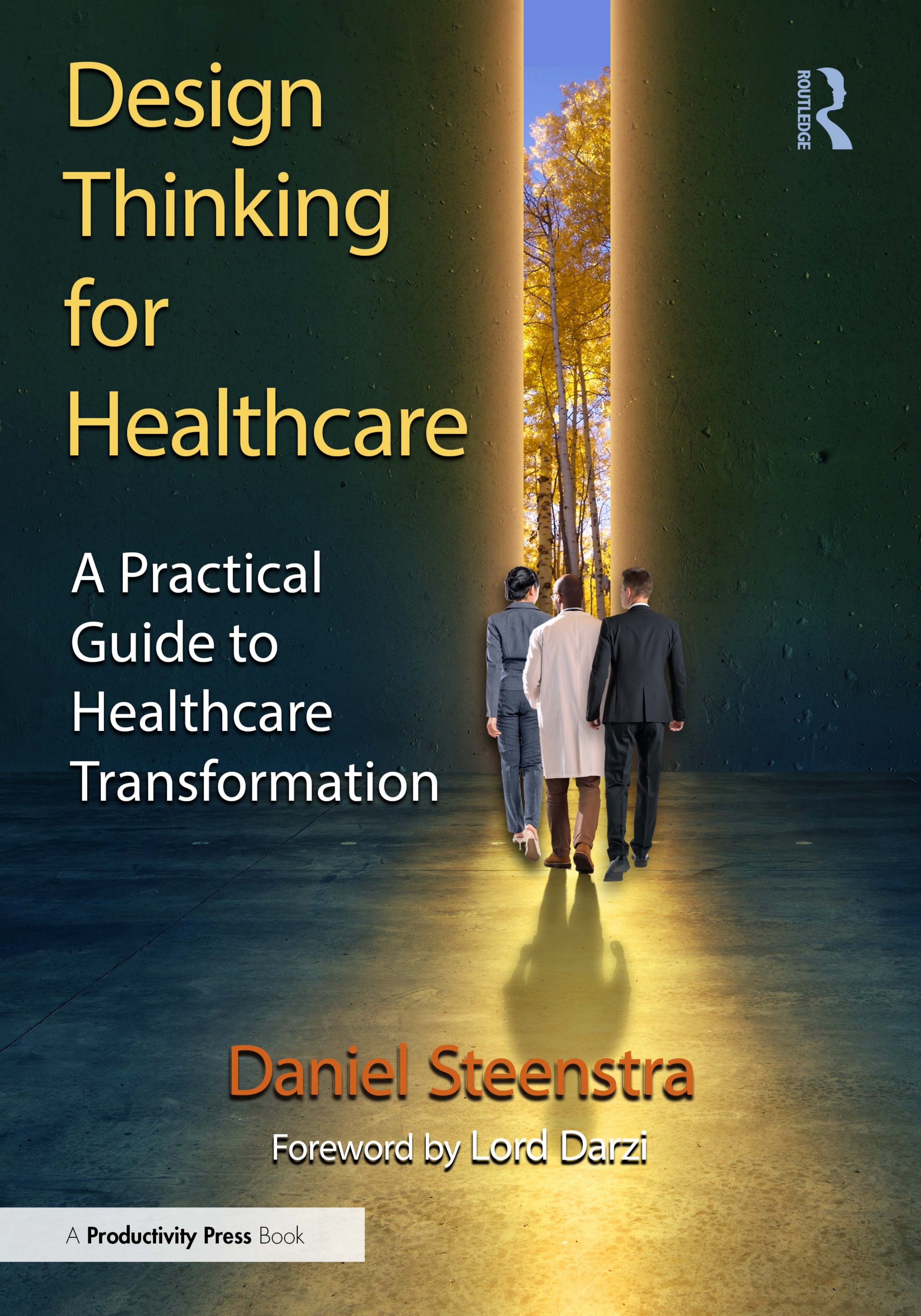
Design Thinking for Healthcare: A Practical Guide to Healthcare Transformation
Daniel Steenstra · with a foreword by Professor the Lord Darzi of Denham, OM, KBE, PC, FRS
Productivity Press (Routledge / Taylor & Francis) · published 5 October 2026
Everything on this page may be used without asking. For interviews, a review copy or anything not here, write to daniel@interalign.org.
Book facts
| Title | Design Thinking for Healthcare: A Practical Guide to Healthcare Transformation |
|---|---|
| Author | Daniel Steenstra |
| Foreword | Professor the Lord Darzi of Denham, OM, KBE, PC, FRS |
| Publisher | Productivity Press, an imprint of Routledge / Taylor & Francis |
| Publication date | 5 October 2026 |
| Extent | 328 pages, 20 black-and-white illustrations |
| Paperback ISBN | 978-1-041-26933-5 |
| Hardback ISBN | 978-1-041-26939-7 |
| Publisher page | routledge.com/9781041269335 |
From the foreword
“This book will not make it simple. It will make it more honest, more disciplined, and more likely to produce results that persist.”
Lord Darzi read the full manuscript before he wrote the foreword.
About the book
Healthcare transformation is failing. Decades of reform and billions in investment have left the $4.3 trillion US healthcare system and the NHS delivering declining outcomes, workforce burnout, and operational dysfunction. The programmes multiply. The results disappoint.
The human cost is tangible. Around the world, growing numbers of people are denied the healthcare they need — the knowledge and capability exist, but the systems meant to deliver care are too badly designed to reach them. That is a moral failure as much as a systemic one. It is the reason this book was written.
It is written for healthcare executives, clinical directors, policymakers, and innovation leaders driving — or struggling to drive — that change.
The clinical workforce transformation leaders are trying to engage already possesses the core capability they need. The diagnostic reasoning of good clinical practice — deep observation, iterative refinement, solutions fitted to the specific situation — mirrors the design process precisely. The challenge is unlocking what already exists and directing it systematically at the design of care systems, alongside the delivery of care.
Design Thinking for Healthcare provides the framework and the field manual to do this. Drawing on the author's combination of nine years of medical training, eleven years as a professional designer at Michelotti and Jaguar, and twenty-five years teaching design thinking to engineering and business leaders, it delivers a comprehensive guide spanning clinical trials, AI implementation, policy design, and organisational change.
Part IV diagnoses why transformation initiatives collapse — structural traps, political dynamics, and the institutional resistance that defeats even well-designed programmes. Part V goes further: practical tools, 90-day roadmaps, and a fully customised implementation field manual to begin transforming your organisation immediately.
Equitable, sustainable, effective healthcare is within reach. Here is how to build it.
The instrument
The book supplies the knowledge. You put it on your own organisation with the instrument. What you make is yours.
InterQB-it™, at interqbit.com.
Author biographies
50 words
Daniel Steenstra is clinically trained, spent eleven years as a professional designer at Carrozzeria Michelotti and Jaguar Cars, and taught design thinking at the University of Warwick for twenty-five years. His first book, Design Thinking for Healthcare (Productivity Press), carries a foreword by Professor the Lord Darzi of Denham.
150 words
Daniel Steenstra combines three domains that rarely meet in one person: nine years of clinical training at Vrije Universiteit Amsterdam; eleven years as a professional designer at Carrozzeria Michelotti in Turin and Jaguar Cars in Coventry, where he project managed the interior design of the Jaguar XK8; and two decades at the intersection of healthcare and innovation, including three years leading the Innovations Factory at Heartlands Hospital Birmingham.
He was the Royal Academy of Engineering's first Visiting Professor in Medical Innovation, hosted at Cranfield University, and taught design thinking to engineers at the University of Warwick for twenty-five years. As Chief Scientist of a US health-AI start-up, he led the system architecture of AI for healthcare equity in underserved populations.
His first book, Design Thinking for Healthcare (Productivity Press, with a foreword by Professor the Lord Darzi of Denham), equips clinicians with the design methods and tools to take on healthcare transformation. He is based in the Netherlands.
300 words
Daniel Steenstra combines three domains that rarely meet in one person: nine years of clinical training at Vrije Universiteit Amsterdam; eleven years as a professional designer at Carrozzeria Michelotti in Turin and Jaguar Cars in Coventry, where he designed and project managed the interior design of the Jaguar XK8; and two decades at the intersection of healthcare and innovation, including three years embedded in an NHS Trust leading the Innovations Factory at Heartlands Hospital Birmingham. He studied the Toyota Production System as Ford's representative.
He was the Royal Academy of Engineering's first Visiting Professor in Medical Innovation, hosted at Cranfield University, and taught design thinking to engineers at the University of Warwick for twenty-five years. As Chief Scientist of a US health-AI start-up, he led the system architecture of AI for healthcare equity in underserved populations. His work spans clinical trials, AI implementation, policy design, and organisational change.
Design Thinking for Healthcare: A Practical Guide to Healthcare Transformation (Productivity Press / Taylor & Francis) is his first book, with a foreword by Professor the Lord Darzi of Denham. It argues that healthcare has been relentlessly improved but rarely designed — and that the capability the design work needs is already in the building: clinicians practise the design process daily through clinical reasoning. This is not a book of workshops, sticky notes and empathy maps: it is a framework and a field manual for healthcare executives, clinical directors, policymakers, and innovation leaders. Part IV diagnoses why transformation initiatives collapse — the structural traps, political dynamics and institutional resistance that defeat even well-designed programmes. Part V equips the reader with the design methods and tools, 90-day roadmaps and a customised implementation field manual to begin immediately.
Daniel is based in the Netherlands. He writes the Design Thinking for Healthcare series at danieliao.substack.com.
Style note for editors. Please write "Daniel Steenstra", with no title. He completed nine years of medical training and is clinically trained. He is not a physician.
Talks
- Recognition, not capability. For clinical and executive audiences.
- Clinically validated, commercially dead. For health-tech and innovation audiences.
- Why transformation fails, and how to diagnose it. For health-system leadership audiences.
Formats: keynote, fireside conversation, panel, workshop, guest lecture.
Recent writing
- Zorgvisie, 24 September 2026 (in Dutch): Stop met zorg verbeteren, begin met zorg design
- BMJ Leader blog, 15 September 2026: Clinicians already reason like designers – they were never given the instruments
- The Design Thinking for Healthcare series on Substack: danieliao.substack.com
Appearances
- 30 September 2026 · HETT, ExCeL London · panel
- 6 October 2026 · University of Warwick (WMG) · launch lecture, Why transformation fails, and what you already have to fix it
Downloads


Contact
Daniel Steenstra · Managing Director, InterAlign Organisation Ltd
daniel@interalign.org · LinkedIn